


More excuses for Europe's WC demise


Europe's smarting rugby nations have no end of excuses for their World Cup capitulation.
The four semifinalists this weekend – New Zealand and South Africa, Argentina and Australia – are all from the South and that is a World Cup first. A stain for the old North.
"They are the Brazilians of rugby, they are fast and they win 80 percent of the duels," said French coach Philippe Saint-Andre after McCaw's world champion All Blacks brushed aside his team 62-13 in their quarterfinal on Saturday.
That was the biggest win in a knockout stage game.
 It followed England's 13-33 humiliation at the hands of Australia that sealed their fate as the first World Cup hosts to go out in the group stages.
England on Monday launched a gloomy inquest into its national team system with coach Stuart Lancaster fighting for his job.
Fortunately for Saint-Andre he was already due to leave his post when France's campaign finished.
Pierre Camou, president of the French Rugby Federation, called the the campaign a "total failure."
While Scotland may argue that they should be in the final four after the referee wrongly awarded Australia a winning penalty, and Wales went down with a brave fight to South Africa. Ireland were soundly beaten by Argentina.
Wales coach Warren Gatland, a Kiwi, reckons "the advantage of the Southern Hemisphere is the weather and playing in conditions instead of what we have up here in November, December and January."
Other coaches and rugby chiefs look more to training basic skills, the organisation of leagues and rugby politics to explain European rugby's struggle.
The southern nations "play a more open game and develop a skill set," according to Scotland coach Vern Cotter, another New Zealander tasked with improving the fortunes of a European side.
Paul Ackford, a former England international, said the Southern Hemisphere is dominant because of "the quality of the international and domestic competitions in that part of the world and the exemplary skill sets of the players who grace them.
"There is more ball-in-play time. Tries, not goalkickers, are the currency that has largely decided the quarterfinals," he wrote in The Times newspaper.
Coaches in New Zealand, Australia, South Africa and Argentina all point to the Rugby Championship and Super Rugby continental club competition that will next year be extended to Argentina and Japan.
Super Rugby has brought a more athletic and faster international-level rugby to the club game.
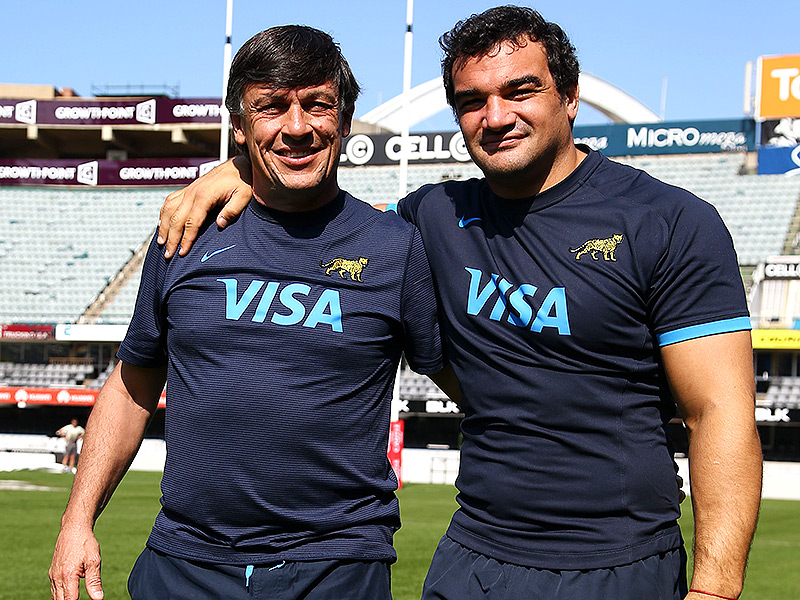 Argentina were hailed as a team packed with skill and ambition – exemplified by kicker Nicolas Sanchez and try-scorer Juan Imhoff – after they beat Ireland.
Argentina coach Daniel Hourcade said joining the Rugby Championship in 2012 had been a huge boost.
"Playing on a regular basis you need precision and this kind of game becomes normal. We trained to play for 80 minutes and we're used to the end of the game being more intense than the beginning," he said.
Camou pointed at the influence of France's Top 14, the world's wealthiest league, but which has shut out French players just as the Premier League is accused of not bringing through enough English talent and instead preferring foreign imports.
"The kids don't play [in Top 14]. They never play. But the best training is playing," Camou told AFP.
He also wants France to study central contracts – as they have in New Zealand, Australia, who earlier this year made an exception for players with over 60 caps playing abroad, and Ireland – which make sure players are free for internationals and set a limit on the number of club games to avoid burnout.
There have been at least two Southern Hemisphere nations in the semifinals at every World Cup so far and the clean sweep this time ensures that a seventh out of eight titles will be southbound.
England in 2003 are the only European winners.
Not everyone believes in the divide however.
World Rugby chief executive Brett Gosper optimistically said that both Wales and Scotland could have got through to the semifinals.
"I don't think you can draw a broad conclusion that there is a gulf between north and south."
Ireland coach Joe Schmidt who completes the New Zealand triumvirate in charge of Six Nations teams said: "I think that divide is not a chasm.
"On any given day we have seen Northern Hemisphere teams compete with Southern Hemisphere teams," said the 50-year-old, who guided his side to wins over both South Africa and Australia last November.
"The risk for us is we've got to be at our very best to be competitive. Even if they are a little bit below par they can still be incredibly dangerous against us."
Agence France-Presse
