


ALL BLACKS 1976: From club rugby to Springboks


New Zealand’s 1976 tour to South Africa has a rich tapestry of Legends and lore.
However, before Andrew Roy Leslie and his All Blacks arrived in the Republic, a number of interesting developments occurred on the rugby fields in South Africa.
That includes two players who played for the Stellenbosch Third XV in the annual Varsity match against UCT, who went on to become Springboks.
More about that later.
(Continue below …)

In 1976, the All Blacks toured South Africa, with the blessing of the then-newly elected New Zealand Prime Minister, Rob Muldoon.
The five Māori players on the tour, Bill Bush, Sid Going, Kent Lambert, Bill Osborne and Tane Norton, as well as ethnic-Samoan Bryan Williams, were offered honorary ‘white’ status in South Africa.
The All Blacks achieved a record of 18 wins and six losses, with three of those defeats in the four-Test series against the Springboks.
A few weeks before the All Blacks’ arrival, UCT beat Maties 10-3 in the main match.
It featured a host of players who were already Springboks or would later become Springboks.
In those days, club games would be littered with Springbok and provincial players, unlike the modern era where national team players are a rare sight even in the Currie Cup.
However, I want to start with the line-ups for the match between the two universities’ third XVs.
In the Stellenbosch Third team pack there were Shaun Povey (hooker) and Rob Louw (No.8).
Both were to become Springboks a few years later.
Povey toured with the Springboks to New Zealand and the USA in 1981, as a replacement for Willie Kahts. He did not play in any Test matches on tour, but played in two tour matches for the Springboks.
Louw specialised as a loose forward. He had speed, agility and anticipation and could handle the ball like a three-quarter.
In 1975 he was selected for a South African Under-21 team that included Gysie Pienaar, Divan Serfontein, and Schalk Burger Sr.
He played the first of his 19 Tests against the South American touring team (before Argentina started touring as a country) and his last Test was against the same South American team in 1984.
As a forward, he had the weight as well as mobility. He was fast enough to play among the backs and had the habit of popping up whenever and wherever he was least expected. With that knack, he scored a wonderful try against the 1980 Lions. Louw was a superb ambassador for South Africa on the 1981 tour of New Zealand. His friendly manner and attractive personality overcame many obstacles.
At scrumhalf for the UCT Third team was Alan Solomons, who studied law at the University of Cape Town, then practised law for 20 years, before pursuing a professional coaching career as the assistant coach for Western Province (winners of the Currie Cup), the Stormers & the Springboks.
(Continue below …)
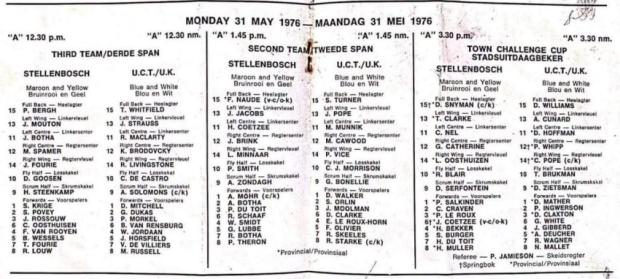
In the Maties Second XV, there was another famous coach at scrumhalf, Alan Zondagh, who has been involved in professional rugby his entire working career. Since the 1980s, he has been coach or Director of Rugby at Western Province, Eastern Province and the Bulls in South Africa, and London Scottish and Saracens in the UK. In 2005, he founded the Rugby Performance Centre, where talented players were prepared for the demands of the professional game. He is also the author of the book Attack! Attack! Attack! (The founding principle of rugby, the core component, is to pick up the ball and run with it – to attack.)
Other notable names in the Maties second team were Frikkie Naude, Jannie Brink, Pete Smith and another famous Springbok in Hempies du Toit (listed under his proper name of Pieter).
Pieter Gerhardus du Toit, now a famous wine farmer in the Helderberg Valley near Stellenbosch, made his provincial debut for Western Province in 1979. He also played for representative teams such as the South African Barbarians, the Proteas and the Junior Springboks. In 1980 he represented the Junior Springboks against the touring British Lions team.
Du Toit was first selected for the Springboks in 1980 to tour South America. He did not play in any Test matches on the South American tour and made his Test debut for the Springboks during the 1981 tour of New Zealand in the first Test on 15 August 1981 at Lancaster Park in Christchurch. The last of his five Tests was against England at Ellispark, in 1984.
The two First XVs were littered with provincial and international players.
Stellenbosch’s team had 10 players who would play for Western Province and five for the Springboks, some who were already internationals, fullback Dawie Snyman and flank Jan-Boland Coetzee.
Coetzee made his Test debut in the first Test against the 1974 British & Irish Lions, then spent some time as an unused replacement, and he would eventually play another five Tests, the last against the 1976 All Blacks at Ellispark.
Snyman made his debut against England in a losing cause in the one-off Test at Ellis Park in 1972, but went on to feature in nine more internationals, the last against World Invitation XV at Loftus Versfeld in 1977.
Scrumhalf Divan Serfontein, as well as locks Hennie Bekker and Schalk Burger senior, would become Springbok regulars during their careers, while flyhalf Robbie Blair would kick the winning conversion for Western Province against the All Blacks later that year.
Captained by legendary No.8 Morné du Plessis, Western Province featured local greats like Peter Whipp and Bossie Clarke (both of whom played for UCT in the Varsity match).
This legendary clash also marked the senior provincial debut of the 21-year-old scrumhalf, Serfontein, who went on to captain both Western Province and the Springboks.
New Zealand dominated the early and middle parts of the game, building an 11-0 lead through tries by Lyn Jaffray and Duncan Robertson, as WP flyhalf Robbie Blair struggled with his boot, missing his first eight attempts at goal.
Western Province began their dramatic late resurgence when wing Bossie Clarke scored an opening try. With only two minutes remaining on the clock, captain Morné du Plessis launched an attack that sent left wing Chris Pope over in the corner to bring the score to 11-10.
Under immense pressure, Blair slotted the winning conversion from a difficult angle near the touchline to snatch a miraculous 12–11 victory.
The main players in this dramatic comeback were all involved in that Varsity Match at Newlands on May 31.
New Zealand had carried a 28-match unbeaten streak (tour matches and Tests) stretching back to 1973.
@JanDKrugby
@rugby365com
