


Springboks v All Blacks: Five classic clashes


‘When South Africa plays New Zealand, consider your country at war.’
Boy Louw, a iconic South African prop and forward who played in the 1930s and later served as a bombardier in World War II, minted those words.
They were spoken ahead of the fierce 1949 All Black tour of South Africa, where the Springboks famously whitewashed New Zealand 4–0.
It highlights the absolute intensity, fierce national pride, and physical combat that defined the historic rivalry between the two nations.
The rivalry between New Zealand’s All Blacks and South Africa’s Springboks is widely regarded as the greatest in world rugby.
It was once called ‘The battle of the giants’.
Now it is ‘Rugby’s Greatest Rivalry’.
And it gets underway at Ellis Park on Saturday, the first of four Tests.
(Continue below …)

Spanning over a century since their first Test in Dunedin in 1921, these two giants have claimed seven of the 10 World Cup trophies and maintain positive records against every other rugby nation.
The contest began on August 13, 1921, when New Zealand defeated South Africa 13–5.
It took the All Blacks 35 years to secure their first series win in 1956, while South Africa won a series in New Zealand as early as 1937.
Off-field politics frequently overshadowed the sport.
The 1981 Springbok tour of New Zealand triggered the country’s largest mass civil unrest due to South Africa’s apartheid policies.
It was captioned “the barbed wire tour”, because intense, nationwide protests forced the New Zealand government to erect massive barbed-wire and razor-wire barriers around pitches to keep demonstrators from stopping the matches
Tours stopped entirely until August 1992 in Johannesburg, following South Africa’s readmission to World Rugby.
The 1995 World Cup Final provided a healing touch.
That was one of many great and highly entertaining contests on the field.
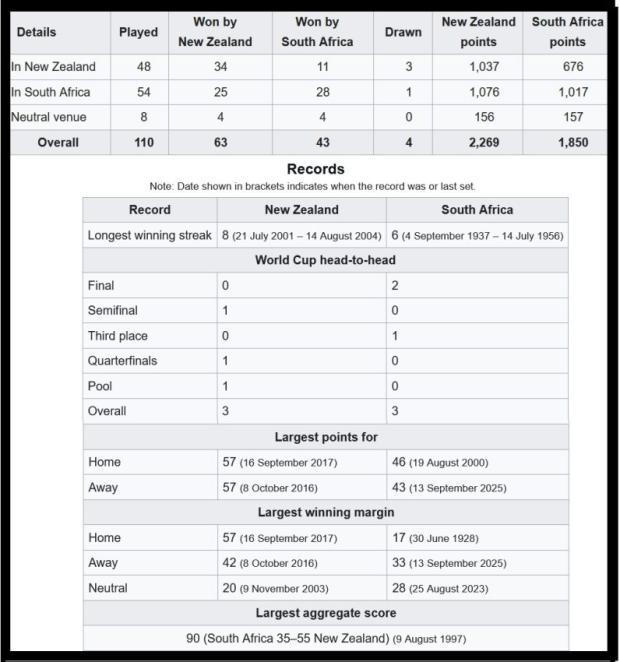
Between 1921 and 2000, the head-to-head battle remained remarkably close, with New Zealand holding a narrow 27–26 edge.
However, the first 17 years of the 21st century saw a heavy shift.
New Zealand accumulated a 31–10 record during a time of global dominance, which also crossed paths with administrative and coaching struggles in South African rugby under Rudolf Straeuli (2002–2003) and Allister Coetzee (2016–2018).
The hiring of Rassie Erasmus as Springbok coach in 2018 completely revitalised the fixture.
South Africa holds an 8–6 advantage (with one draw) under his guidance.
Out of 110 matches, New Zealand has won 63, South Africa 43, and four have been drawn.
Both teams hold the scars of their heaviest losses to each other: New Zealand crushed South Africa 57–0 in 2017, and South Africa fired back with a record 43–10 routing of New Zealand in 2025.
* Below I will highlight five of the best contests in 105 years of rivalry!
5. New Zealand 6-17 South Africa (Eden Park, Auckland, September 25, 1937)
The 1937 South Africa tour of Australasia is one of the most successful Springbok tours in history and therefore is referred to as the ‘Invincibles’. The team was captained by Philip Nel.
The 1937 team remains the only Springbok team to have won a series in New Zealand and was a team which included such names as Danie Craven and Boy Louw.
Having whitewashed Australia 2 nil (after a 10-match tour), the Invincibles crossed the Tasman Sea and played three Tests against New Zealand, the series one-all after the first two encounters.
The Springboks then drew a huge crowd of 50,000 at Eden Park, Auckland, to see South Africa win the third Test against New Zealand 17–6.
It was the first time that South Africa had won a Test series in New Zealand.
The victory came in the form of a five-try-to-nil win, which would have been 27–6 under the current scoring rules.
The hero of the day was Louis Babrow, who scored two tries.
Babrow almost did not play in the match as he was an observant Jew and the match fell on Yom Kippur.
However, he saw no reason to keep away as the sun had not risen over South Africa when the match started in New Zealand.
The 1937 touring side, captained by Philip Nel, is remembered to this day as one of the great teams of yesteryear that featured the legendary Danie Craven.
Scorers
New Zealand
Pens: Dave Trevathan 2
South Africa
Tries: Louis Babrow: 2, Ferdie Berg, Freddy Turner, Dai Williams
Con: Gerry Brand
4. New Zealand 11-5 South Africa (Eden Park, Auckland – 1 September 1956)
‘Absolutely buggered.’
It was the view of an exhausted All Blacks number 8, Peter Jones, who gave this account in a live radio broadcast.
After a thrilling victory over South Africa (11–5) at Eden Park in Auckland, New Zealand won a Test series against South Africa for the first time since the two teams first faced each other in 1921.
With a record-breaking crowd of 61,000-plus watching, the All Blacks clinched the series against their bitter rivals.
The game was a gruelling battle between opposing forwards, and it served as the ultimate contest between the forwards of both teams.
The New Zealand prop forwards Skinner and Clarke and their illustrious partner Ian Clarke formed a wall that kept out their South African counterparts, Jaap Bekker and Harry Walker.
It is remembered as one of the most challenging Tests in history.
The first half was a tactical battle, with the only points coming from a penalty kick by All Blacks fullback Don Clarke.
Don Clarke kicked his second penalty early in the second half to put New Zealand ahead by 6–0.
The most exciting moment for the match came when Northland loose forward Peter Jones took up a loose ball just in front of the half-line.
He fought off several would-be defenders to run nearly fifty meters before touching down in the corner for a stunning try. Clarke landed a difficult sideline conversion kick to make the score 11–0.
South Africa responded by launching a series of powerful attacks that forced the All Blacks to defend desperately down their own throat.
The Springboks then scored a try through Roy Dryburgh and a conversion kick from Basie Viviers.
Scorers
New Zealand
Try: Peter Jones
Con: Don Clarke
Pens: Don Clarke 2
South Africa
Try: Roy Dryburgh
Con: Basie Viviers
3. New Zealand 25-22 South Africa (Eden Park, Auckland, September 12, 1981)
The ‘Flour Bomb’ Test marked the end of the infamous ‘barbed wire’ tour by way of a raucous encounter.
It was the third and final Test match of the highly charged 1981 Springbok tour, when New Zealand won the deciding match, which helped clinch a 2-1 series victory over South Africa, despite the tour being shrouded in controversy and civil unrest.
This match is forever known as the ‘Flour Bomb Test’. This was one of the most anticipated encounters in rugby due to the unrest across New Zealand as it was played out in full view of heavily armed police, barbed wire on the perimeter fences, and large crowds of anti-apartheid protesters.
Marx Jones and Grant Cole, two anti-tour protesters, rented a Cessna 172 light plane and circled the stadium at low altitude during the match, dropping flares, leaflets, and flour bags on the pitch.
One of the most famous images of this match came when New Zealand prop Gary Knight was ‘attacked’ by a flour bag hitting his head and fell to the ground. He was able to continue playing, as his teammate joked, ‘don’t pour water on him, he might set’.
The game was stopped numerous times due to the nuisance of the low-flying aircraft and flour bombing.
However, the game saw one of South Africa’s most exciting performances of the tour as Ray Mordt scored a hat-trick of tries while continuing to break through New Zealand’s line of defence.
New Zealand replied with tries from lock Gary Whetton and wing Bernie Fraser. And fullback Allan Hewson added the steady boot.
As the clock was showing time up, and the score at 22-all, Welsh referee Clive Norling told the Springbok captain Wynand Claassen that the game was over, but play continued long into extra time due to the ‘incredible’ amount of time stopped due to the low-hanging nuisance of the aircraft.
In the 89th minute, and after nine minutes of extra stoppage time, Norling awarded New Zealand a penalty which was placed calmly and confidently by fullback Allan Hewson to finish 25-22 and win the series for New Zealand.
Scorers
New Zealand
Tries: Gary Whetton, Bernie Fraser
Con: Allan Hewson
Pens: Doug Rollerson, Allan Hewson 3
DG: Doug Rollerson
South Africa
Tries: Ray Mordt 3
Cons: Naas Botha 2
Pens: Naas Botha 2
* In 1981, a try was worth 4 points
2. South Africa 15-12 New Zealand (Ellis Park, Johannesburg, June 24 1995)
This iconic match was the first World Cup Final to be decided in extra time.
The game was much more than a match, as it was a uniting force for a recently democratised, post-apartheid South Africa.
Then there was the Madiba Magic!
President Nelson Mandela took to the turf wearing a Green and Gold No.6 Springbok jersey, the same as the white captain Francois Pienaar, which helped bind the 43-million South Africans to their new rugby team.
The Wall!
The Springboks effectively stopped rampant New Zealand teenager Jonah Lomu, who had been unstoppable in the tournament to this point.
Then there was the ‘Suzie’ mystery that surrounded the food poisoning that incapacitated most of the All Blacks just 48 hours before the Final, blamed on a waitress with the unfortunate name of ‘Suzie’.
The All Black management denied it had anything to do with the dodgy seafood establishment a large group of players had visited in the week.
Both teams failed to score a try during the match.
It was left to Joel Stransky to kick in all 15 of South Africa’s points, scoring three penalties and two drop-goals.
The last of these, a 30-metre drop-goal in the second extra period, brought an amazing victory.
Conversely, Andrew Mehrtens accounted for all 12 points by scoring three penalties and a drop-goal.
Scorers
South Africa
Pens: Joel Stransky 3
DGs: Joel Stransky 2
New Zealand
Pens: Andrew Mehrtens 3
DG: Andrew Mehrtens
1. South Africa 12-11 New Zealand (Stade de France, Paris, October 28 2023)
During their championship run at the 2023 World Cup, the Springboks achieved an unprecedented trilogy of consecutive one-point victories during the knockout stages.
Displaying supreme psychological resilience and defensive grit under pressure, South Africa navigated the quarterfinal, semifinal, and Final by a combined aggregate margin of just three points to lift the Webb Ellis Cup for an unprecedented fourth time.
They are also only the second team to achieve back-to-back World Cup wins.
The three legendary matches that defined this historic, high-stakes gauntlet include:
1. Quarterfinal: South Africa 29–28 France. 15 October 2023. Facing the host nation in front of a fiercely partisan Parisian crowd, this game is widely regarded as one of the greatest Test matches ever played.
2. Semifinal: South Africa 16–15 England. 21 October 2023. In a rematch of the 2019 World Cup Final, England executed a brilliant, wet-weather tactical game plan. Driven by the boot of Owen Farrell, England choked the Springboks’ attack and built a seemingly commanding 15–6 lead heading into the final quarter. Coach Jacques Nienaber emptied the bench, the Bomb Squad, spearheaded by the destructive scrummaging of Ox. After an RG Snyman try cut the deficit, Handré Pollard stepped up to slot a monstrous, match-winning 78th-minute penalty from past the 50-metre line.
3. Final: South Africa 12–11 New Zealand. 28 October 2023. The ultimate iteration of rugby’s greatest rivalry. All Blacks captain Sam Cane was red-carded in the first half, but New Zealand fought back heroically despite playing a man down. The Springboks relied strictly on the flawless first-half goal kicking of Handré Pollard (who scored all 12 points) and held on despite immense pressure, missed opposition kicks and a late defensive wall to capture a record-breaking fourth world title
It was an incredibly tense, rain-slicked match that saw the All Blacks play with 14 men for most of the game after captain Sam Cane received the first-ever red card in a World Cup Final
Pieter-Steph du Toit’s performance is widely considered one of the greatest individual defensive masterclasses in rugby history.
Affectionately dubbed the ‘Malmesbury Missile’, the towering blindside flank put on a relentless ‘seek-and-destroy’ showcase of a record 28 tackles that earned him the Man of the Match award and cemented his status as a legendary rugby warrior.
A physical and heavily policed match broke the record for cards in a World Cup Final. Apart from Cane, Shannon Frizell, Siya Kolisi, and Cheslin Kolbe were all yellow-carded at various points during the match.
Aaron Smith also appeared to score a spectacular try for the All Blacks in the second half, but it was ruled out by the TMO due to a knock-on earlier in the line-out build-up.
Flyhalf Handré Pollard scored all 12 points for the Springboks, executing four high-pressure penalty goals perfectly in the first half.
Richie Mo’unga kicked two first-half penalties. In the second half, Beauden Barrett scored the only try of the match, but a missed conversion and a late penalty miss left them just one point short.
Scorers
South Africa
Pens: Handre Pollard 4
New Zealand
Try: Beauden Barrett
Pens: Richie Mo’unga 2
@JanDKrugby
@rugby365com
* Any matches you feel deserve a spot?
