


RWC 2027 draw: Who, how and when?


EXPLAINER: The 2027 World Cup draw will take place on Wednesday (09.00 GMT; 11.00 SA time), and the format will be explained below.
It will be the biggest World Cup, with 24 teams, compared to 20 in recent editions.
How does the draw work?
The 24 teams will be placed in six pools of four, A to F.
The top two in each pool, plus the four best third-placed teams, will all reach the last 16 knockout round.
Those four teams will be determined by competition points first, and if that doesn’t separate the sides, then points difference and try difference will be the next factors used respectively to determine which teams make it out of the pool stage.
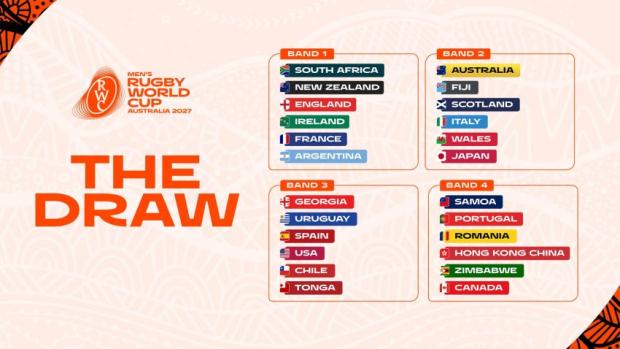
For the draw, teams are split into four bands of six, based on world rankings. Band 1 is South Africa, New Zealand, England, Ireland, France and Argentina.
Those six will be in separate pools in the first round.
Joining them in each pool will be one team each from bands 2-4 (drawn randomly). The lowest-ranked teams are in band 4.
The draw will take place at a television studio in Sydney with the participation of former New Zealand World Cup winner Dan Carter and Australia prop James Slipper, who retired earlier this year after his 151st cap.
Hosts Australia are in band 2, so a theoretical “Group of Death” could be: South Africa, Australia, Georgia (from band 3) and Samoa (band 4).
The Springboks are reigning champions and currently top the rankings.
At the other end of the scale, Hong Kong have qualified for the first time in their history.
Band 1: South Africa, New Zealand, England, Ireland, France, Argentina
Band 2: Australia, Fiji, Scotland, Italy, Wales, Japan
Band 3: Georgia, Uruguay, Spain, United States, Chile, Tonga
Band 4: Samoa, Portugal, Romania, Hong Kong, Zimbabwe, Canada
How will the Round of 16 work?
In previous formats, the quarterfinalists would just be the winners of each pool against the runners-up of another pool.
With six pools feeding 16 spots in the first round of the knockouts, that requires some changes.
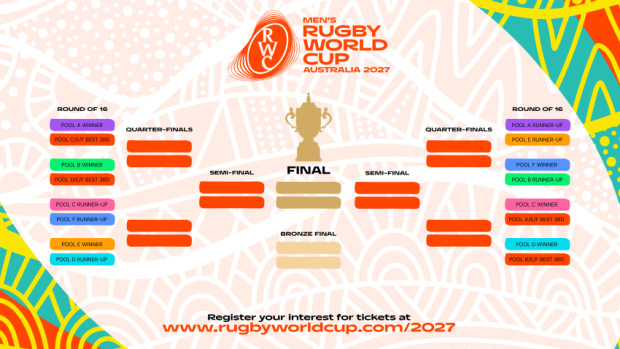
The teams that finish top of Pool A, B, C and D will face a third-place team in the Round of 16, while the teams that finish top of Pool E and F will face teams that finished second in their pool.
Likewise, some teams that finished second in their pool may face the winner of another pool, while some will face the runners-up.
While on the surface that may seem slightly unfair, that imbalance is addressed in the next round. Let’s take Pool A and Pool E as an example. The team that wins Pool A will face a third-place team in the Round of 16, but in the quarterfinals could potentially meet the winner of Pool B if that team wins their Round of 16 match.
On the other hand, the team that wins Pool E will face a runner-up rather than a third-place team in the Round of 16, but in the quarterfinals would face the winner of a quarterfinal between two other runners-up.
So, while the winner of Pool A would face a third-ranked team and then potentially a top-ranked team in their games, the winner of Pool E would face second-ranked teams in both games.
Which teams have qualified?
The 12 teams that finished in the top three of their pools at Rugby World Cup 2023 have automatically qualified for Rugby World Cup 2027.
Those teams are: France, New Zealand, Italy, Ireland, South Africa, Scotland, Wales, Fiji, Australia, England, Argentina and Japan.
The 12 remaining places were reserved for teams that qualified through various regional tournaments, including this year’s Rugby Europe Championship and Rugby Africa Cup.
These teams are: Georgia, Spain, Romania, Portugal, Tonga, Canada, United States, Uruguay, Chile, Samoa, Zimbabwe and Hong Kong China.

Some key differences
More teams mean an extra knockout round and slightly more matches – 52 games compared to 48 last time.
Another change is from five teams in each pool to four, so one fewer match for each team in the group stage.
For example, when South Africa won the World Cup 2023, they played seven games: four in the pool stage and a quarterfinal, a semifinal and a final.
If they were to reach the Final in 2027, they would still play seven games: three in the pool stage, then Round of 16, a quarterfinal, semifinal and Final.
Source: World Rugby with additional reporting by AFP
